Thursday, April 14, 2011

L is for Lutry

I had many options for L, nearly all of them Swiss-centric: Lausanne, Luzern, Lugano, Locarno, Lac Leman, the Lavaux...but I had to decide on just one.  So I picked my favorite place in Switzerland: Lutry.

Lutry is a small town east of Lausanne, situated in incredibly picturesque surroundings on the northern shore of Lake Geneva (Lac Leman in French).  It lies on the western edge of the Lavaux wine region, recently named a UNESCO World Heritage Site.  When you look to the east, you see the beautiful terraced vineyards of the Lavaux (pictures courtesy of my friend, since I sadly have no pictures of Lutry for some reason):


When you look across the lake, you can see France and the Alps:


Along the lake there is an excellent stand for ice cream.  And the town itself is beautiful -- an old church and narrow alleys are just what you expect of a medieval European town.  All of these aspects factor into why Lutry is my favorite place in Switzerland, but the most important factor is the Caveau de Vignerons ("wine-growers' cellar).  I was introduced to the caveau not long after I arrived in Switzerland by two of my closest friends there.  As you can tell from the pictures, Lutry is situated near vineyards, but in truth there are vineyards within the borders of the town itself (including right by its train station).  Wine is a big part of the town's identity.  The caveau is, as the name suggests, collectively owned by all the wine-growers in Lutry (basically a cooperative) and serves only wine made in the two appellations in the Lutry region: Lutry and Villette.  The caveau is run by two people (who are not wine-growers) named Pascal and Francoise.  We got to know Pascal very early on, as he speaks English and is wonderfully friendly, and taught us much about Lavaux wines (I will keep the topic of Swiss wines for another time).  The caveau is a popular hang-out for locals, situated in an old cellar-like room, now decorated with photos and art and sporting tables made out of large wine barrels:

(Source: montreux-vevey.com)

If you look very carefully, there are a ton of plush monkeys hanging over the bar -- that is because monkeys are the symbol of Lutry.  Anyway, my friends and I spent many hours in the caveau, drank many bottles of wine, and it was a favorite destination for all of us to bring visiting friends and family members.  In the summer we would bring plastic cups, grab a bottle of chasselas (a white wine), and sit by the lake drinking before retiring to the caveau for the inevitable bottles of red wine.  In September we would all come to Lutry for La Fete des Vendanges, the festival celebrating the grape harvest.  On one of my last days in Switzerland, I visited the caveau and told Pascal I was leaving, and he gave me a bottle of pinot noir made in Lutry.  He told me to save it for a day when I missed Switzerland.   I miss Switzerland often, but so far I have kept the bottle in a safe place.

Wednesday, April 13, 2011

K is for Kvothe

I was going to milk this for two A to Z posts, but I was struggling to find a good K idea, and a recent Penny Arcade comic (warning: minor spoilers) inspired me.

Who is Kvothe?  Kvothe is the main character of The Kingkiller Chronicle, a fantasy trilogy-in-progress by Patrick Rothfuss.  He debuted with The Name of the Wind in 2007 and recently published A Wise Man's Fear (out just a month ago).  The basic premise of the trilogy is that Kvothe, an infamous, near-legendary figure, has retired to a sleepy town and adopted the persona of Kote the innkeeper.  He is accidentally found by a scribe named Chronicler, who convinces Kvothe to tell his story for posterity.  The Name of the Wind is subtitled The Kingkiller Chronicle: Day One, just as A Wise Man's Fear is subtitled The Kingkiller Chronicle: Day Two, because Kvothe insists that the telling of his story will take three days (hence a trilogy).  And while Kvothe's story dominates the two novels, there are also dark and important events transpiring in the present, which no doubt will become increasingly more important as Kvothe's story draws to a close.

What do I like so much about these books?  Well, I enjoy the story-within-a-story format, though that is by no means novel.  I like Kvothe as a character.  I am impressed by Rothfuss's storytelling prowess, and most of all I really dig his treatment of magic.  See, Kvothe is known by many epithets, such as Kvothe Kingkiller (hence the name of the series) and Kvothe the Arcanist.  Yes, he is a wizard (of sorts), though not in a traditional fantasy sense; in fact, I do not think the word 'wizard' is ever used.  Kvothe learns magic in the course of his life, and there are two principal kinds: sympathy, which is basically a sort of arcane thermodynamics-meets-quantum mechanics, and the much more powerful but mysterious naming, which more or less involves knowing something or someone's truename, and thus gaining power over that thing or person.  The "name of the wind" refers to just such a truename.

Now the novels are not without their problems.  Kvothe's life story is far more interesting (so far) than what is happening in the present, so the portions of the novels that return to Kvothe's current situation as an innkeeper are comparatively slow (though important details and events do occur).  And much of the story deals with Kvothe trying to making ends meet, which while realistic is oftentimes trying, because you know Kvothe is and will be capable of great and terrible things, and as the reader you are waiting expectantly to see at least glimpses of these abilities.

Nonetheless, The Kingkiller Chronicle is my favorite fantasy series in recent memory, and alongside A Song of Ice and Fire, has forced me to break my previously mentioned fantasy novel rules:
  1. I do not read series more than five books in length.
  2. I do not read as-of-yet-unfinished series.
I highly recommend it to anyone who enjoys a classic coming-of-age tale supported by good storytelling, an interesting world (though so far we only have hints of what it all contains), and refreshing take on magic.

Tuesday, April 12, 2011

J is for Jamón Ibérico de Bellota

Let's stick with the food theme for a little bit.  While I was living in Switzerland, I was introduced to the wonderful world of charcuterie, preserved or cured meats (usually made of pork).  In the US, typically our exposure to things like salami, ham, and sausage is via sandwiches.  What I discovered in Switzerland is that Europeans really enjoy these by themselves.  One of my favorite stands in the Saturday market in Lausanne sold all manner of dried sausages and cured meats.

On a whim, one day I bought a relatively expensive package of Spanish ham labeled jamón Ibérico de bellota, and my view of ham was transformed.  I had tried prosciutto, jambon cru, and jamón Serrano, but never before had I tried jamon Iberico, and boy was I in for a surprise:

Jamon Iberico de bellota (from cervezayjamon.com)
Just look at that ham!  Look at the sheen, the beautiful intramuscular fat.  When I tasted it for the first time, I was surprised by the fact that it was not salty or smoky (usually flavors I associate with hams of various sorts), but incredibly rich and a little bit sweet, like pork should be.  I also quickly noticed that if you leave jamon Iberico out at room temperature, the ham begins to glisten because the fat is nearly liquid at room temperature!

Since then, I have gone out of my way to have more jamon Iberico de bellota, and to learn more about it (mainly from Wikipedia, as usual -- lazy, I know, I should use primary sources).  Jamon Iberico is sometimes called pata negra ("black hoof"), which also references the breed used for jamon Iberico, called the black Iberian pig.  This breed of pig is prized for its intramuscular fat (those lovely white streaks in the ham pictured above) and likes to graze in forested pastures, which leads to the reason for the bellota ("acorn").  In wooded pastures called dehesa, these pigs roam about and feast on acorns from several species of oaks, consuming up to a kilogram of acorns per day. This makes jamon Iberico de bellota the highest grade of jamon Iberico; most of the pigs are not fortunate enough to live this life -- lower grades of jamon Iberico are made from pigs grazed on grain or a combination of grain and acorns.  The free range lifestyle and the acorns no doubt account for much of jamon Iberico de bellota's wonderful flavor, and in addition, the acorn-rich diet results in a high level of monounsatured fat -- thus the near-liquid consistency of the fat at room temperature.      

I am still relatively ignorant about just how good jamon Iberico de bellota can get, but I look forward to trying the Spanish hams offered at DiBruno Brothers and hopefully, one day, going straight to the source in Spain.

Monday, April 11, 2011

I is for Italian Hoagie

I have a thing for sandwiches.  I attribute it to growing up outside Philadelphia, where hoagies, cheesesteaks, and roast pork sandwiches.  My formative sandwich experience (I know this is a bit bizarre - people don't usually talk about formative sandwich experiences) was at the preeminent local sandwich shop in my hometown of Wayne, a place called John's Village Market.  They have an amazing Italian hoagie (still my favorite), which is the subject of today's blog post.

For those unfamiliar with a hoagie, it is a sandwich served on a long Italian roll and topped with cold cuts, vegetables, and cheese.  "Hoagie" is a regional term -- I pretty much only hear people from southeastern Pennsylvania and New Jersey use that name; elsewhere names like submarine sandwich, grinder, or hero can be used, though oftentimes these names have additional nuanced meanings.  In Philadelphia, the hoagie reigns supreme, and at the top of that pile is the Italian hoagie. 

An Italian hoagie is dressed with oil, sometimes oil and vinegar or a special house Italian dressing (but never, EVER, mayonnaise), loaded with Italian-style deli meats -- capicola, some sort of ham (I like pepper ham), and Genoa salami are nearly givens, while pepperoni, and occasionally mortadella and prosciutto are used -- and then topped with Provolone cheese, lettuce (romaine or Boston is the best, though iceberg is still used way too often), tomato, onion, and quite often pickled peppers (usually sweet, though you can get hot -- I always go sweet peppers).  Sometimes you get a shake of oregano or "spices" to top it off.  The bread is very important -- an Italian long roll (sometimes seeded) either makes or breaks the sandwich.  The result looks something like this:

An Italian hoagie from Dalessandro's (from Roadfood.com)
See how much stuff is in there?  That is important -- this is not some French baguette with one slice of cheese and one slice of meat artfully hidden within the bread.  The secret of the Italian hoagie is all the different textures and flavors mashed into a single sandwich that you can barely fit into your mouth -- but when you do it is an experience that really cannot be topped by any other sandwich.

I actually have not had Italian hoagies from very many different places, and I know I've missed some standouts in Philadelphia, but my top Italian hoagie list currently looks something like this:
  1. John's Village Market, Wayne: The meats they use on the hoagie are spicy like no other Italian hoagie I've had, and they are very generously sized.
  2. Salumeria, Reading Terminal Market: I only recently had their Italian hoagie, and it was fantastic.  They eschew the traditional pickled peppers for roasted red peppers and artichoke hearts, if you want them.  At the suggestion of a friend, I also had their prosciutto hoagie with the house dressing and artichoke hearts, and that may even be better!
  3. Paesano's, Philadelphia: Their Daddy Wad is a fancier Italian hoagie (mortadella, sopressata, and prosciutto, among others) topped with arugula instead of lettuce.  A great sandwich from Philly's best sandwich shop.
  4. A Cut Above Deli, Newtown Square: I mentioned this deli in a previous post about Ridley Creek, and they did not disappoint.  The hoagie is served on a seeded roll.
So there you go.  I'd love to hear about more places I should visit to have Italian hoagies -- Sarcone's is a glaring omission here and is definitely on the list.  If you've never had an Italian hoagie, you need to have one at least once -- but unless you find a place in the Philadelphia area or nearby New Jersey, it just isn't going to be the real thing.

Saturday, April 9, 2011

H is for Hohtürli

Prior to living in Switzerland, I had done a little bit of hiking, but never as a regular activity.  In Switzerland, hiking became something I really enjoyed, and I looked forward to the start of hiking season every spring.  One of the best things about Switzerland is that hiking is very civilized.  What does that mean?  You can hike high into the Alps, be surrounded by snow-capped mountains, glaciers, and rugged, rocky terrain, and yet only be an hour away from civilization.  Many of the best hikes I did in Switzerland included fantastic mountain restaurants part way through the excursion, at the highest points of the hike! 

One of the best examples of this is the Hohtürli, a mountain pass in the Bernese Alps.  My friend and I decided to do this hike in September 2009.  My friend, who lives in Switzerland, has over the years done most of the stages of the Via Alpina, a multi-stage hike across Switzerland that traverses 14 different passes in the Swiss Alps.  One of the passes he had not yet done was the Hohtürli, the highest pass (at 2778 m) along the Via Alpina, between the village of Griesalp and the town of Kandersteg.

We met in the Bern train station on a cloudy weekend, and after a bit of confusion and some running, we got on the BLS train to Reichenbach im Kandertal, where we transferred to a PostBus.  In fact, there were two PostBuses going to Griesalp, our destination, and we ended up on the smaller one, and this would be important shortly.  Both buses followed the same route into a valley called the Kiental, but after awhile we ended up at the base of what looked like a cliff.  Our bus continued on, while the people on the larger bus had to get off, and board a smaller bus waiting for them.  We soon discovered why, as our bus wound its way up the forested cliff along a very narrow, switch-backing road, at one point squeezing between two huge rock faces.  After some ascent, we arrived at the trail head in Griesalp.  I later learned that this was apparently the steepest bus route in Europe!

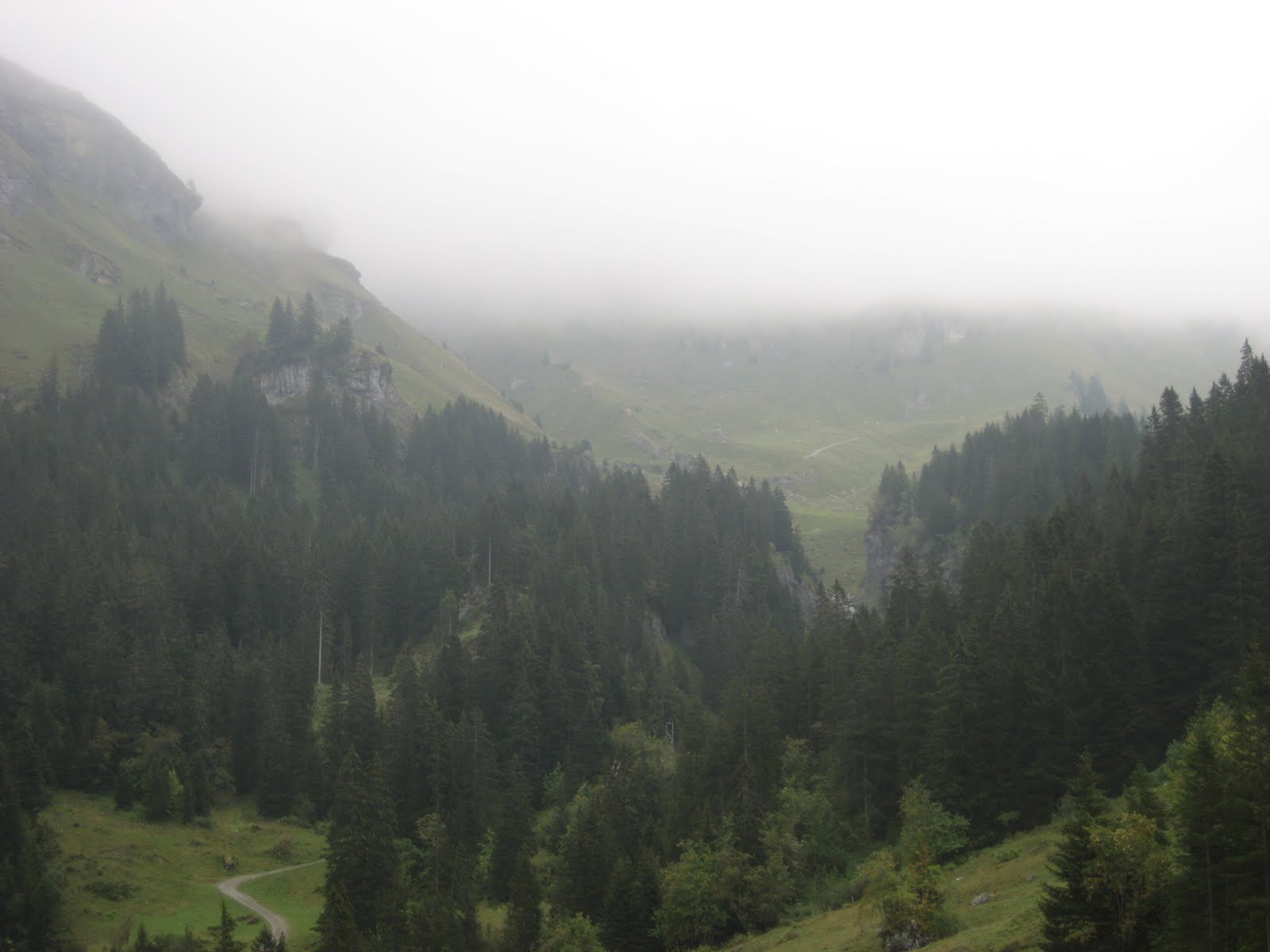
It was still misty when we left Griesalp, so unfortunately we did not get the grand views we were hoping for, but the panoramas from the village were still beautiful:


We marched up into the mist, eventually rising above the tree line.  Here we were greeted by Alpine pastures clouded in mist and covered with marmots!  Never had I seen so many marmots in the wild, all in one place, making their little marmot noises.  We continued to ascend, and the path steepened:


Finally, the clouds broke and we saw some blue sky and mountains:


Unfortunately, the clear skies did not last, and the final push to the Hohtürli was made in mist:


That last stretch nearly killed me, I think, as the path got so steep that steps, and in some places chains or railings, were put in place.  But then we finally made it!


Because of my friend's murderous pace, we had reached the top in three hours, a climb of 1400 m from Griesalp.  But as it turned out, the descent was steep and just as hard:


Even though the sign at the top said Kandersteg, our destination, was only 3 hours, 15 minutes away, it proved a much slower slog.  Still, the terrain along the way was rugged, wild, and breathtaking, and included even more marmot sightings:


After having a bite to eat while sitting on a glacier-deposited boulder, we made our way towards a mountain lake called the Oeschinensee.  At this point, our legs were like rubber, so we were looking forward to taking a chairlift down from the Oeschinensee to Kandersteg, saving ourselves an hour of walking and 400 m of steep descent.  We were forced to make another steep descent along a cliff face over the lake, and by the time we reached the resort area on the shores of the lake, the chairlift had stopped for the day :(  We pushed through another hour and finally reached Kandersteg, dead-tired, but excited that we had conquered the Hohtürli.  This was easily the hardest hike I had done in Switzerland: steep climbs and ascents, an elevation gain to the pass of 1400 m and a drop from the pass to Kandersteg of almost 1800 m, all over a distance of about 15 km.  All told, it took us around 7.5 hours, including a couple breaks to eat.  And while I still wish the weather had been clearer, it was one of the most rugged and memorable hikes I enjoyed while living in Switzerland.

If you want to do this stage of the Via Alpina, check out the official route from Wanderland.ch.  Highly recommended!

Friday, April 8, 2011

G is for Grosser Aletschgletscher

The Aletsch Glacier (Grosser Aletschgletscher or "Great Aletsch Glacier" in German) is the largest glacier in the Alps, measuring over 20 km in length.  It is located within the Swiss Alps Jungfrau-Aletsch UNESCO World Heritage Site in southern Switzerland.  And hiking to and along the glacier is one of my favorite hikes in all of Switzerland -- in fact, I enjoyed it so much that I did some variation of the hike three times.   My favorite version of the hike starts up in the mountains, after a cable car ride up to a small resort village called Fiescheralp.  From Fiescheralp, you start hiking around a mountain peak called the Eggishorn.  About 30 to 45 minutes into the hike, you are greeted by this view:


Beautiful, am I right?  But the best part is, this isn't even the Aletschgletscher; this is the smaller, nearby Fieschergletscher.  A little bit farther into the hike, you move through an alpine valley, and eventually reach the Grosser Aletschgletscher: 

I took that picture myself!  Pretty amazing, isn't it?  And my meager photography skills do not even begin to capture the majesty of the glacier, or the beauty of the surrounding mountains.  That view is pointed towards a place called Konkordiaplatz, where three different smaller glaciers come together to form this one massive river of ice.  If you get down right next to the glacier, you can actually climb on it, and check out a small lake called the Märjelensee, which is filled with ice:


You continue to walk above the south edge of the glacier, enjoying an ever-changing view.  If you are lucky, you might even see some marmots!


Finally, after six hours, you end up in another mountain resort town called Bettmeralp:


This hike is extremely popular with the Swiss and tourists alike.  It is not too difficult, though it is quite long, but if you are already planning on visiting Zermatt and seeing the Matterhorn, the Aletschgletscher is only 1.5 - 2 hrs away, and worth it.  Here are my pictures from 2006, 2008, and 2009, and if you are interested in doing the hike as I described, I recommend this description from Activity World.

Thursday, April 7, 2011

F is for Fried Spider

YES!  I really wanted a reason to post these pictures again, and now I have it!


That's right, that is me chowing down on a fried spider, a delicacy I enjoyed when I visited Cambodia in 2008.  According to Wikipedia, the species of spider used in Cambodia is the Thai zebra tarantula.  I figured it was some sort of tarantula, because it was pretty large -- the legspan was larger than the palm of my hand, easily:


I did not travel to Skuon, the epicenter of fried spiders in Cambodia, but instead had this particular morsel during my first evening in Phnom Penh, the capital city of Cambodia.  I had told my friend for some time that I wanted to try one, so she knew exactly where to go, and when I asked for one, the woman running the cart made me pick.  I had no idea what to do, so I picked one that looked like a spider (eight legs, venomous fangs, stuff like that), and paid 1000 riels (about $0.25) for it.  The cart also featured huge beetles (or cockroaches, I was not quite sure), the biggest crickets I have ever seen, and what I think was a small species of python (or maybe a baby python) on a stick.  I regret not trying the snake, though a few days later I did have python at a restaurant in Siem Reap.

What does it taste like?  Well, they fry it with garlic and sugar and what I assumed was something like soy sauce, so it was crunchy, salty-sweet, and garlicky.  The cephalothorax of the spider contained a flaky white meat, reminiscent of crab, but I could not really taste anything distinctive about it.  The abdomen, which contains a lot of organs, had a discernable taste, something like the muddy flavor I associate with eating a shrimp head, or any of the various parts in the head of a lobster.  Not great tasting, but not terribly offensive, either.  I suppose the best part of eating a fried spider are the looks you get from your friends :)